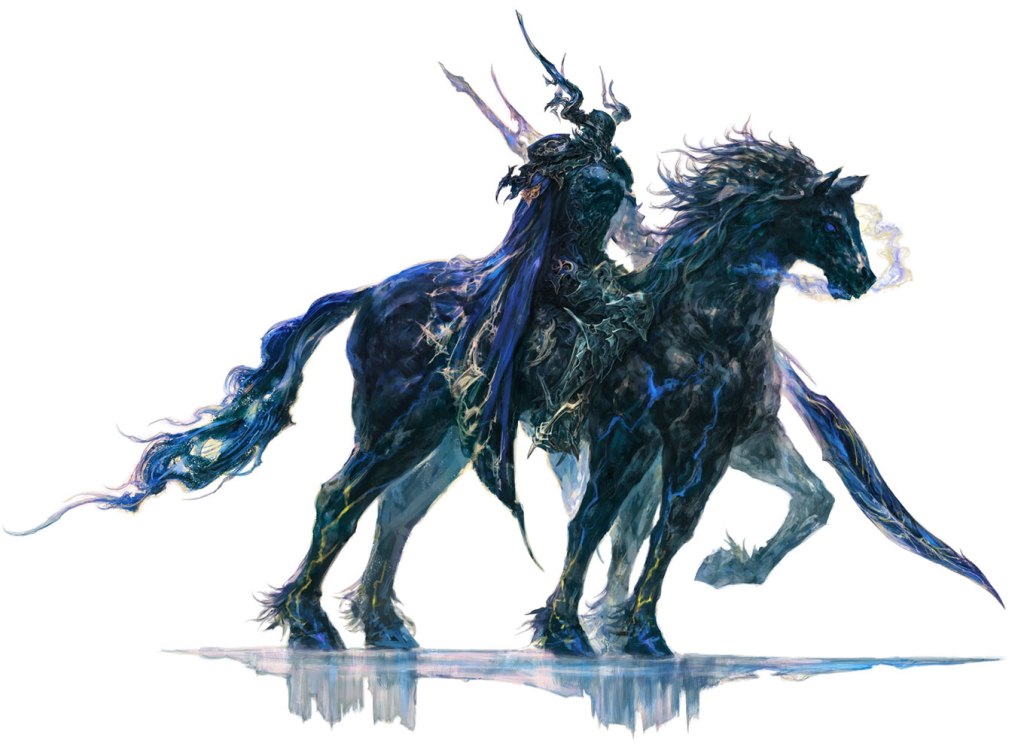
I’ve been contemplating working on another Making Sense of… style post about the ending of Final Fantasy XVI because there are some understandable confusions about the ending. But the other one that I’ve seen popping up is complaints about the fight in the game with Odin.
For those who haven’t completed 90% of Final Fantasy XVI, this here be thy SPOILER WARNING.
So, late in the game Clive faces off with Barnabas Tharmer, the King of the nation of Waloed and the dominant of Odin. The central complaint as I understand it is that the fight doesn’t really utilized the fully primed and summoned Eikonic form of Odin and Ifrit very much. Compared to the previous fights featuring Titan and Bahamut, which were these massive cinematic kaiju battles – it seems strange that the final dominant is fought with barely seeing his Eikon for the vast majority of it.
Oh sure, most of the fight is done with Barnabas “semi-primed” or channeling his Eikon’s ability into his basic human form without completely turning into Odin. But it does seem fairly lackluster compared to Lost Titan’s mountain sized form or Bahamut ascending to the levels of nigh-“Bahamut Zero”. But – and follow me on this one – I think that was the point? Thematically at least.
I know that just saying that something mechanically in a Final Fantasy game is done for thematic reasons is opening a can of worms but I do think it does explain the choice. I mean aside for the fact that Odin as an Eikon is just a tall dude on a horse, and that’s not exactly as interesting as the others (though if they decided to throw back and have him turn into Raiden that would have been neat… for me at least. I mean, they threw Mid in there.)
Much of the lead up and interpersonal conflict between Clive and Barnabas is based on a central plot point in the late game: Barnabas regards Clive as an undeserving tool of his God, a vessel of unlimited potential known as “Mythos,” that will allow Barnabas’ God to remake the world and purge humanity of the corruption known as Free Will. And Barnabas does truly believe in his God’s vision that free will is an aberration that must be culled from the populace. Clive, whose story has been all about breaking the chains of the enslaved magic users across the lands of Valisthea, takes exception to ‘free will’ being a corruption and being regarded as a tool to anyone, let alone a God.
So the basic thematic conflict of the battle is one of Barnabas’ will to serve his God versus Clive’s will to be a free human. And thus the ideological battle is not one of titanic figures but one of two individual’s determination and desires. As such, wielding the Eikons’ power would undermine the idea of two diametrically opposed humans battling to determine the fate of humanity.
Clive is thus determined to not call upon Ifrit unless absolutely necessary. To call upon the “vessel of mythos” would be to yield to the God’s designs, and surrender the moral high ground of claiming that free-will would surpass the will of a totalitarian God.
Barnabas’ reasons for not turning to Odin is two-fold. The first? His God needs Mythos. Unleashing the full force of Zantetsuken on even a semi-primed dominant would ensure that the precious vessel would be lost. However, Barnabas has also been tasked to break Clive’s will. To do that, he needs to face the outlaw on his own terms and best him to prove beyond a shadow of a doubt that his God and his faith are the future.
Could this have been accomplished in the narrative with a big eikon fight? Yes. Absolutely. No reason it couldn’t have. But I don’t think it would have had the thematic weight. After all, this is the only fight with a dominant where things are resolved between two men and not two deific monsters and I think the game wants us to focus on why that is.
It’s a fight between two humans for the fate of humanity. And I can’t think of a more classic way to handle that than a sword duel at the top of tall tower while it’s raining.
Might just be me though.
 VRYKERION
Leave a comment